
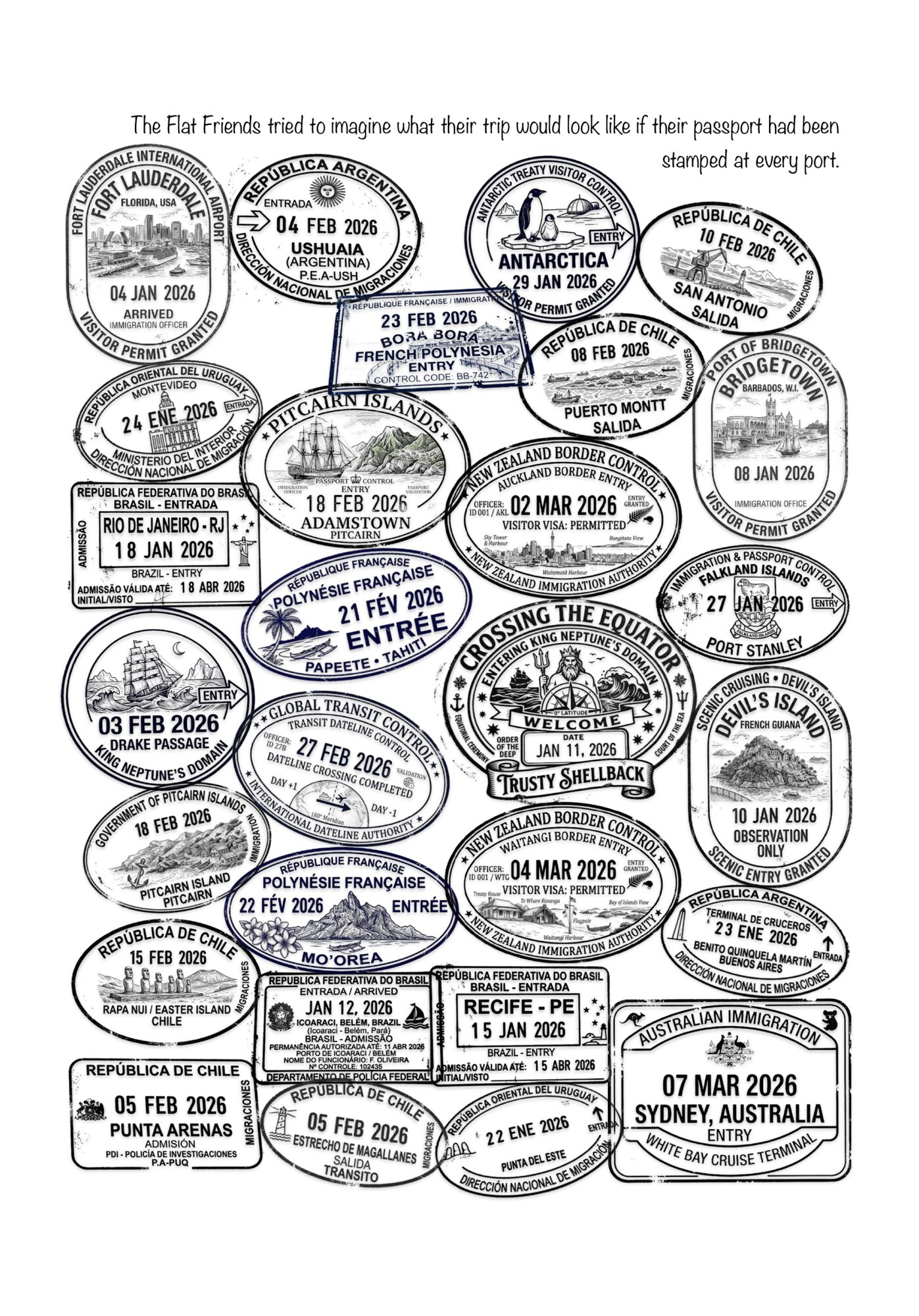


Real passport stamps are in the language of the country stamping your passport… English for the United States, French for France, etc. We made these stamps for our trip, so the languages aren’t always right, but we tried. What languages do you see in the stamps? For which countries? Does this glossary help you understand them better?

Did You Know? 🌍
Ink-redible History: In the old days, every single time you entered a new country, a person called an Immigration Officer would have to press a heavy rubber stamp into a tray of ink and then onto your passport. If they didn’t press hard enough, the stamp would look “distressed” or faded! (Many stamped you out also.)
The Shape Tells a Story: Did you notice that some stamps are rectangles while others are ovals or circles? Many countries use different shapes to show if a traveler arrived by plane, ship, or train.

A “Shellback” Secret: Look for the King Neptune stamp! This isn’t a government stamp—it’s a special “unofficial” honor for sailors and travelers. When you cross the Equator (the invisible line that splits the Earth into North and South), you transform from a “Slimy Pollywog” into a “Trusty Shellback!” And there are a few different types of Shellbacks, if you cross at special places, like pink if you cross on the Amazon River, or Gold if you cross at the International Dateline.
Travel Without a Passport: In some parts of the world, like the European Union, you can cross between many countries without getting a stamp at all! It’s like walking from one room to another in a giant house.
Souvenirs of the Sea: Since many ships use computers to check people in today, physical ink stamps are becoming rare. These “Flat Friend” stamps are a way to keep a visual diary of every single place the ship’s brought the Flat Friends.
If you could design a stamp for your own hometown, what icon would you put in the middle? A piece of fruit? A famous building? A local animal? A statue or fountain everyone recognizes in town?

The immigration officer looks for any blank space in your passport where they think the stamp will fit. It may overlap others, be turned sideways, and chronological order (putting today’s port after yesterday’s) is a waste of time when there’s an impatient line of people building up. Design your stamp to be simple, and easy to spot surrounded by others.


