
#flatstanley #flathal

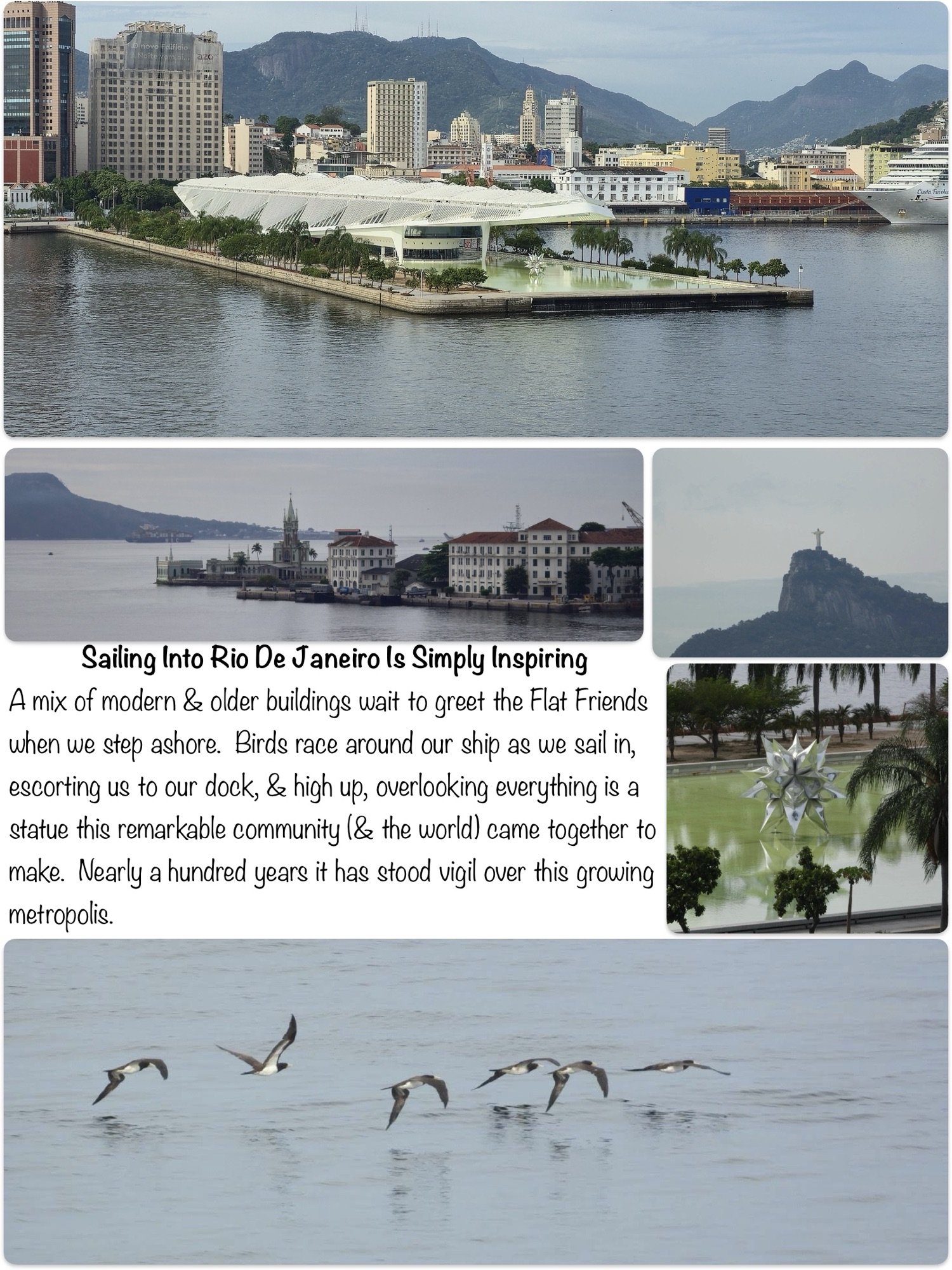
A mix of modern & older buildings wait to greet the Flat Friends when we step ashore. Birds race around our ship as we sail in, escorting us to our dock, & high up, overlooking everything is a statue this remarkable community (& the world) came together to make. Nearly a hundred years it has stood vigil over this growing metropolis.


The Flat Friends ventured 20 miles away from the pier, discovering first hand just how big, and intriguing Rio de Janeiro truly is — if you ever get the chance to visit, keep your eyes peeled! You never know where you might see things from past Carnival/ Festivals outside buildings, just waiting for new life, and cause to celebrate.

Rio’s Growth into a Metropolis
1502 — The Naming: Portuguese explorers enter Guanabara Bay. They name the area Rio de Janeiro (River of January), realizing later it isn’t a River… but it was January.
1763 — The Colonial Capital: Rio becomes the capital of the Viceroyalty of Brazil. It grows as a vital port for the “Gold Cycle,” shipping minerals from the interior to Europe.
1808 —The Royal Shift: The Portuguese Royal Family moves their entire court to Rio to escape Napoleon. This transforms Rio from a colonial outpost into a bustling city with a botanical garden, a library, and a bank.
1902 —The “Great Reform”: Mayor Pereira Passos attempts to turn Rio into the “Paris of the Tropics.” He demolishes old tenements to build wide avenues (like Avenida Rio Branco), which inadvertently begins the city’s sprawl into the hills (favelas).
1931 —The Sentinel Completed: After nine years of construction, the Christ the Redeemer statue is inaugurated on October 12, 1931.
1969 —Westward Sprawl: Architect Lúcio Costa designs the “Pilot Plan” for Barra da Tijuca. This marks the shift from the dense, mountainous center to the “vast” city we drove through this year—characterized by massive boulevards and high-speed transit.
2016 —The Olympic Park in Barra solidifies the West Zone as Rio’s new modern heart, completing the city’s journey from a tiny harbor settlement to a sprawling metropolis.
Rio de Janeiro!

A Statue in the Clouds — Rio is home to Christ the Redeemer,
one of the “New Seven Wonders of the World.” It stands
98 feet tall (about the height of an 8-story building) on top
of a mountain called Corcovado. Sometimes it is so high up
that it’s actually inside the clouds! It was a global collaboration:
designed by Brazilian engineer Heitor da Silva Costa and
sculpted by French artist Paul Landowski. It remains the
largest Art Deco-style sculpture in the world.
The World’s Biggest Party — Rio is the capital of Samba music! Every year, they host Carnival, where thousands of dancers in colorful costumes and huge floats parade through the streets. It is the biggest festival in the world.
Sugarloaf Mountain — Right at the edge of the water, there is a giant rock shaped like a “loaf of sugar.” Visitors have to take a cable car swinging high above the ocean just to reach the top. It’s a great place to look back and see the ships in the harbor!

Read previous Rio journal entries at: http://www.flathal.xyz/archives/tag/rio-de-jainero
How has your own hometown changed over time?
Rio grew from a tiny harbor to a massive city stretching over 20 miles!
Ask an adult or visit your local library to find a photo of your street or a favorite park from 50 years ago. What is there now that wasn’t there then?
Is there a building or statue in your town that ‘stands vigil’ and tells a story about your community’s past?
Flat Hal calls a place near Austin, Texas, home.
When he went looking for answers he discovered 50 years ago his “home” was part of a working ranch!

As for a building that stands vigil, Austin has two, the State Capitol Building, which he has journaled about visiting. There’s also the U.T. Tower which, come to think of it, he has visited but didn’t journal about!
Just like Christ the Redeemer has watched Rio grow for nearly 100 years, the Texas State Capitol (finished in 1888) and the U.T. Tower (finished in 1937) have watched Austin grow from a small town into a big city
Is there something special like that in your home town you could write a journal entry about?


