
#flathal #flatstanleyproject #Nagasaki #Japan

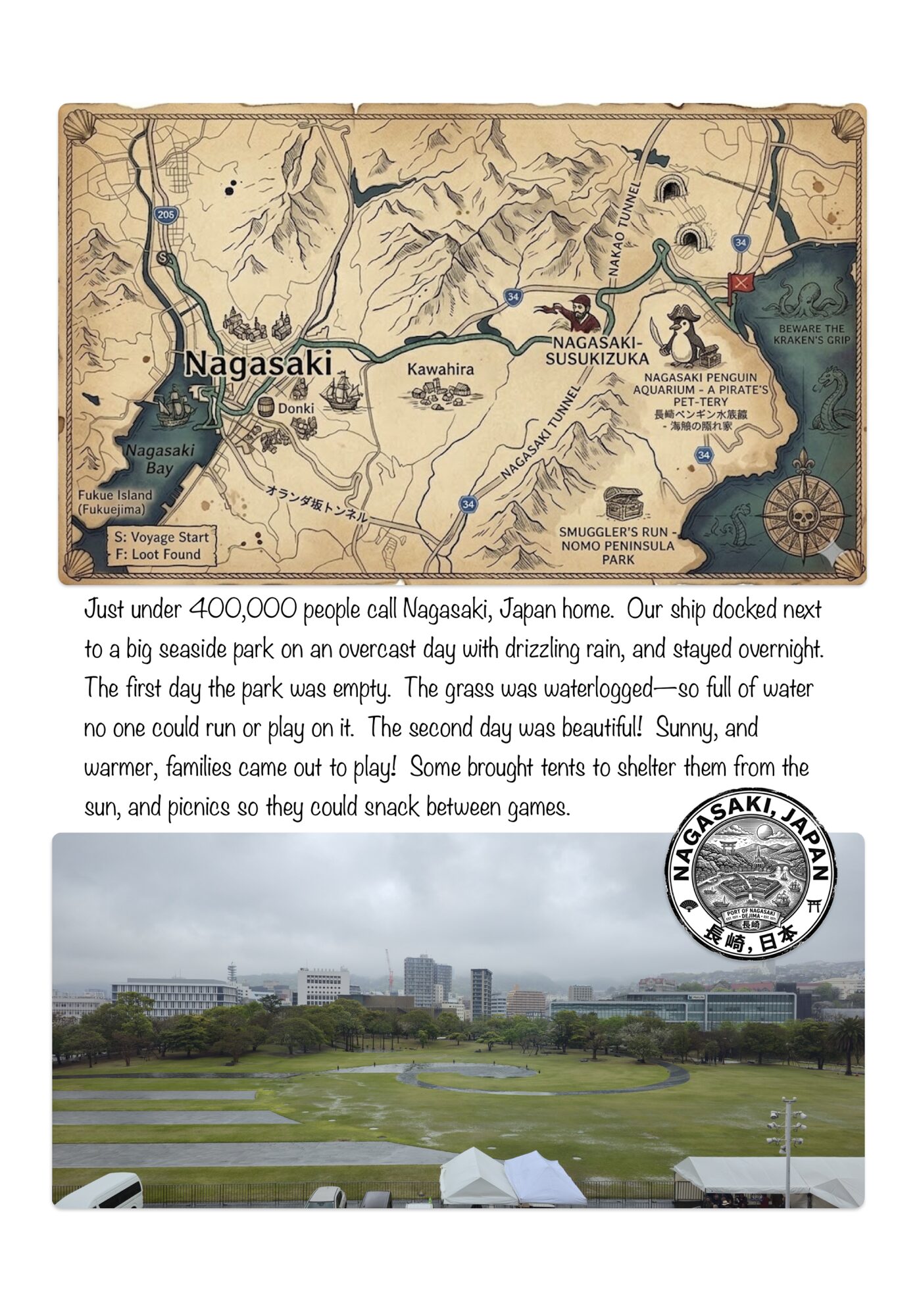
Just under 400,000 people call Nagasaki, Japan home. Our ship docked next to a big seaside park on an overcast day with drizzling rain, and stayed overnight.

The first day the park was empty. The grass was waterlogged—so full of water no one could run or play on it. The second day was beautiful! Sunny, and warmer, families came out to play! Some brought tents to shelter them from the sun, and picnics so they could snack between games.

The Flat Friends headed to the Nagasaki Penguin Aquarium with high hopes of seeing all 9 types of Penguins that live there.

We put together a checklist, with hints on how to tell the Penguins apart at the Aquarium. We want to try and figure out if we succeeded in getting a photo of each of the nine.
We planned to spend the most time in the “Temperate Zone and Others”. We knew going in that we saw King Penguins, Gentoo Penguins, Magellanic Penguins, and one of the two types of Rockhopper Penguins in the Falkland Islands just two months ago. Last year Flat Hal and Flat Stanley saw Chinstrap Penguins at a distance in Antarctica, but that was going to be a new one for Flat Halena.
Humboldt Penguin is the type none of us were able to spot at Bird Paradise in Singapore—we were getting a second chance! We were also getting a first chance to see African Penguins, Little Penguins and the other type of Rockhopper. (Time to check our notes—have we already seen the Southern? It would make sense for the Falkland Islands in the Southern Hemisphere.)
As an added bonus, our friend Flat Jay joined the cruise in Hong Kong for 17 days—this is his first chance to see penguins!

Our first bit of excitement at the Nagasaki Penguin Aquarium came at the 4-meter deep diving pool for the Antarctic and really cold weather penguins. At first we could just see a few penguins playing up top, on the surface of the water. Then, suddenly, three dove down and started swimming laps, back and forth in front of the windows, zooming around so fast they were hard to keep track of. Sometimes they would shoot up to the surface, then dive back down to play some more.

Gentoo are the fastest of the penguins when they are underwater. They can go just over 20 mph, that’s almost as fast as cars go in front of a school! Trying to get a picture in focus of these fast-moving birds was a fun challenge for the flat friends.
In Antarctica we saw groups of Gentoo penguins flying through the water—popping up to grab a breath. Here we could truly see how they move through the water and appreciate their speed.

We had seen the Southern Rockhopper on land in the Falkland Islands, but hadn’t spotted one swimming until now. It was fun trying to make out its bushy yellow eyebrows as it sped past!

During our scenic cruising of Antarctica last year, Flat Hal saw a colony of chinstrap penguins on Elephant Island.

It is easy to remember where we saw them because on the island is a bronze bust of Captain Luis Alberto Pardo Villalón. The statue of this Chilean naval officer’s head and shoulders celebrates his work to rescue Ernest Shackleton’s stranded crew after their ship was lost in the ice. (Do you remember our journal entry about Ernest Shackleton?)

Our focus still on penguins, we went upstairs to the second floor. Here we found where the penguins had been diving down from.

Their environment here seemed to be divided into sections. One had access to both the water and “dry land”, the other had plexiglass separating it from the pool—it looked like it wasn’t time for their class to have access to the pool. It felt as if the groups were taking turns.

Upstairs the Flat Friends could see penguins swimming on the surface of the pool, and waddling around it. Identifying them is our current challenge! We think we caught 4 different types of penguins on camera!


We moved to the next enclosure. In the process we changed environments. We went from the SubAntarctic Zone to the Temperate Zone.

Instead of a thick layer of glass separating us from the REALLY cold penguin area, we were now walking around near them, outside.

Plexiglass walls separated us, but adults could see over them—and the air was cool, but comfortable!

The Humboldt Penguins, Magellanic Penguins and African Penguins were in side by side enclosures outside in the Temperate Zone. Similar to in the indoor enclosure, they had a pool to swim in, as well as some “dry land” to waddle around on—though many stood still as statues, posing for pictures.
We found it challenging to tell the three apart, can you help us spot some differences?

The African Penguin looks like he has a splash of paint above his eyes.

The Humboldt Penguin has pink down by its beak… does noticing this help?

The Magellanic looks like it is wearing an extra black necklace according to some—Flat Halena agrees.

The Flat Friends arrived at the Nagasaki Penguin Aquarium with a goal of seeing the 9 types of penguins that live there. We carefully explored all the enclosures we found. We photographed every penguin willing to pose for us. Flat Halena created a painting from one of Flat Hal’s photos of two penguins swimming!
We had a lot of fun—and feel our day was a huge success.


Even though we only found 8 of the 9 types of penguins, we are thrilled with our day. (And ready to learn more about the Northern Rockhopper that we didn’t even catch a glimpse of.)

There are 18 species of Penguins in the world. The Flat Friends have seen 10 on this voyage—that’s just over half! We made a checklist so we can keep track. It will also help us figure out which ones we need to discover where we can see.


Leave a Reply
You must be logged in to post a comment.