
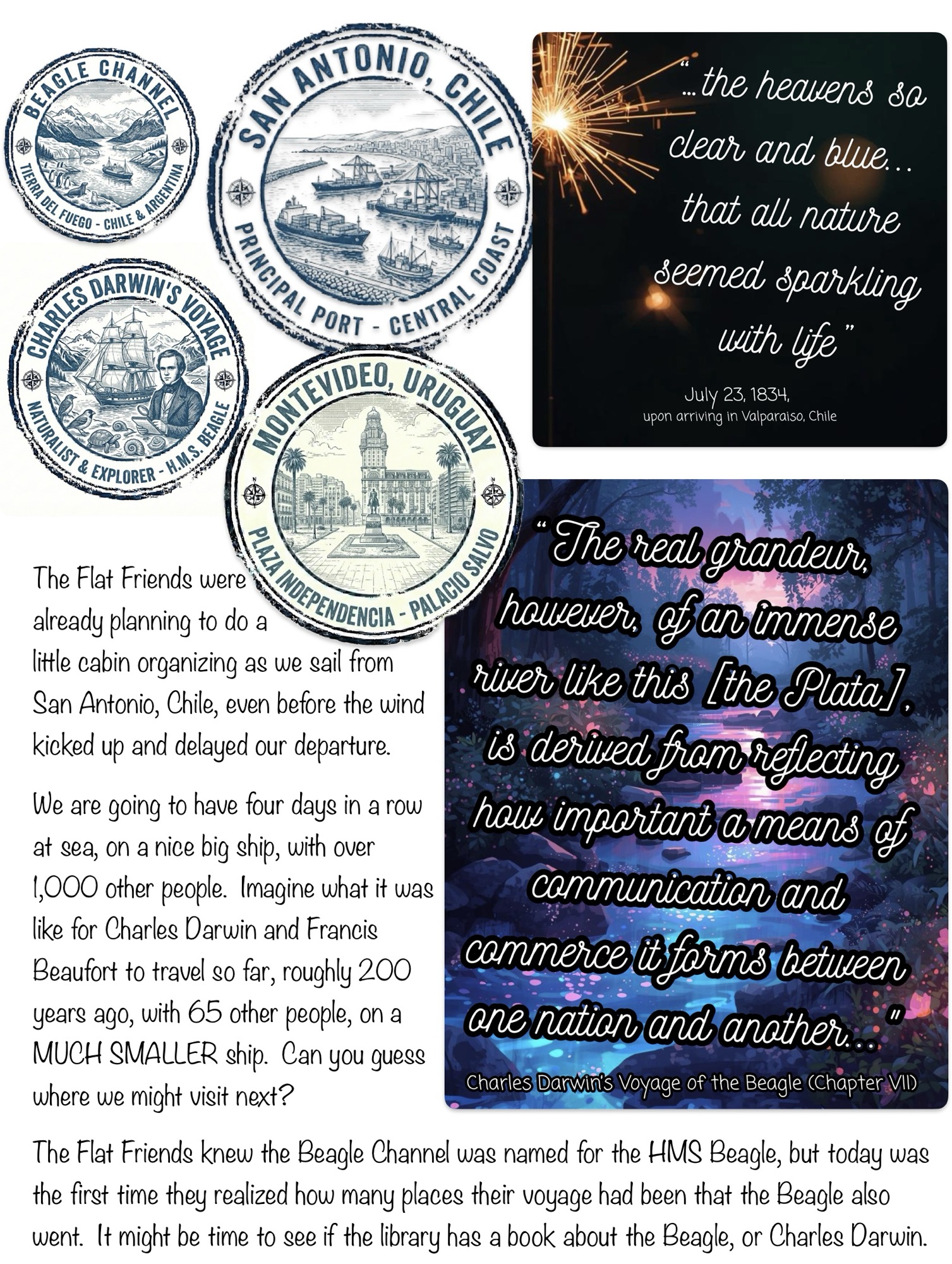

The Flat Friends were already planning to do a little cabin organizing as we sail from San Antonio, Chile, even before the wind kicked up and delayed our departure.


We are going to have four days in a row at sea, on a nice big ship, with over 1,000 other people. Imagine what it was like for Charles Darwin and Francis Beaufort to travel so far, roughly 200 years ago, with 65 other people, on a MUCH SMALLER ship. Can you guess where we might visit next?

The Flat Friends knew the Beagle Channel was named for the HMS Beagle, but today was the first time they realized how many places their voyage had been that the Beagle also went. It might be time to see if the library has a book about the Beagle, or Charles Darwin.


There is a lot to do on a ship — especially when you have four sea days in a row. Play games, read a book, or just sit and visit with friends.
Flat Hal and Flat Halena decided to do some sleuthing! They had questions, and what could be more fun than a hunt for answers?

First question? They happened to be visiting some of the places the HMS Beagle went, but was that REQUIRED to discover fossils and other cool stuff? We knew we could learn all kinds of great things from a book at home — but could we be explorers without traveling?
YES!
The Flat Friends stumbled on a great statement on the internet from Gemini AI: You don’t need a cliff; you just need erosion. Any local creek with rocky banks is cutting through time just like the Colorado River cuts the Grand Canyon, only on a smaller scale.
There’s a creek near Flat Hal’s home! All kinds of discoveries could be out there just waiting for him and Flat Halena (or one of his other pals).
Second question? Did Darwin make any great discoveries near home?
While the Beagle voyage made Darwin famous, he spent the last 40 years of his life at his house (Down House) studying things right under his feet, in his garden. He may have stopped traveling, but he didn’t stop asking questions or looking for answers.
Science is a Team Sport. Ever heard the phrase “lab partner”? Darwin became famous, but he couldn’t have done it without a drummer to steer the ship, a roadie to carry his bag, or a doctor to fix his stomach aches. You don’t have to be the lead singer to change the world!

🎸 The Band: “The HMS Beagle”. World Tour Dates: 1831–1836
🎤 The Lead Singer: Charles Darwin
The Role: The front man. Everyone knows his name, and he gets all the interviews. What he did: He wrote the lyrics (his journals) and came up with the “big idea”. Without the band, he would have just been a guy looking at rocks in England.
🥁 The Drummer: Captain Robert FitzRoy
The Role: The heartbeat. If the drummer stops, the song falls apart. What he did: He kept the rhythm (literally—he was obsessed with time and clocks to navigate). He steered the ship and kept everyone safe. Cool Fact: He invented the “Weather Forecast.” He was the first person to use science to predict if it would rain at the concert!
🔧 The Roadie: Syms Covington
The Role: The guy who sets up the gear and carries the heavy stuff. What he did: Darwin was the “idea guy,” but Covington was the “action guy.” He caught the bugs, and carried the heavy fossils on his back. Cool Fact: Many of the famous “Darwin’s Finches” in museums were actually caught and tagged by the roadie, not the rock star!
📸 The Social Media Manager: Conrad Martens
The Role: The tour photographer. What he did: There were no cameras, so he painted everything. He made sure the fans back home could see what the new world looked like.
🚑 The Tour Medic: Benjamin Bynoe
The Role: Keeping the band healthy. What he did: Darwin was seasick all the time. Bynoe was the ship’s surgeon. He kept Darwin able to go on shore and explore. Cool Fact: He was a scientist too! He collected hundreds of plants, but he was happy playing backup and letting Darwin take the spotlight.
You don’t need a ticket to the Galapagos to make a discovery; you just need to look at a rock and ask, ‘What were you before you were a rock?’”

Flat Hal enjoys Star Trek, a science fiction show about a starship on a 5-year mission of discovery. A day at sea offered a chance to think about how the HMS Beagle was a real-life “starship Enterprise”.


To a person living in England in the 1830s, the Galapagos Islands were just as alien as Mars is to us. The Beagle was traveling to “alien worlds” right here on Earth.
Charles Darwin was the ship’s naturalist (the science officer). His entire job was to find animals and plants that science didn’t know existed — new life!
The main job of the Beagle was actually making the maps (surveying) as they sailed “uncharted seas”. They sailed to the jagged coasts of South America to draw the coastlines so other ships wouldn’t crash. In the process of going where no European had been before, they discovered new (to them) civilizations.


